

Visit to the Gambsheim fish pass (Passage 309)
When I arrived in Alsace, I quickly heard about the Gambsheim fish ladder, but I have to admit I had no idea what it was for or what it might look like! So I was very happy the day I visited it, because I was intrigued by the place. But why on earth do we need to help fish get through? Here's what I discovered!

My summary
I liked
- Original and very interesting visit
- Go behind the scenes on a special tour
- Accessible to people with reduced mobility and strollers
I liked less
- Credit cards are not accepted
- Don’t expect anything too visual, the main point is to understand how it works!
Video summary
Why a fish pass?
It’s impossible to talk about fishways without first mentioning migratory fish, which are species that migrate from freshwater to the sea and then from the sea to freshwater during their lifetime. Among the best-known species are salmon, sea trout, shad, eel and sea lamprey. In our case, on the Rhine, this means that the fish will swim down the Rhine to the sea, then back up again after a while. Quite a sporting performance, isn’t it?
The problem is that there are a number of hydroelectric plants on the Rhine that are problematic for fish, as they can end up in the turbines when they go downstream, or are unable to go upstream because of the dams, preventing them from completing their life cycle… A big problem for fish, but at the same time a great source of renewable energy: the idea of the fish pass is to reconcile the two by helping fish to pass the dam during upstream migration, while continuing to generate electricity.
While no effective technical solution for structures the size of those on the Rhine currently exists, solutions have been put in place to help fish swim upstream by enabling them to pass the Gambsheim/Rheinau dam from downstream to upstream. Yes, because it sounds so simple, but it’s actually extremely complicated from an engineering point of view. Several constraints must be taken into account at once: hydroelectric production, of course, but also the swimming habits of different fish species! Some will swim in the middle of the river, others more on the side, some like to swim upstream in a strong current, while others would tire too quickly with too strong a current…
The Gambsheim-Rheinau fish pass, inaugurated in 2006, is one of the largest fish passes in Europe, and a fine example of a solution that works, with around 60,000 fish passing through every year!

A staircase for fish!
Not all fish enter at the same point: two entrances are provided, one for “big swimmers” like salmon and one for the others, to adapt to their habits. A flow is also created at these two gates by a micro-power station, in order to attract them. That’s right, because migratory fish naturally go where there’s flow!
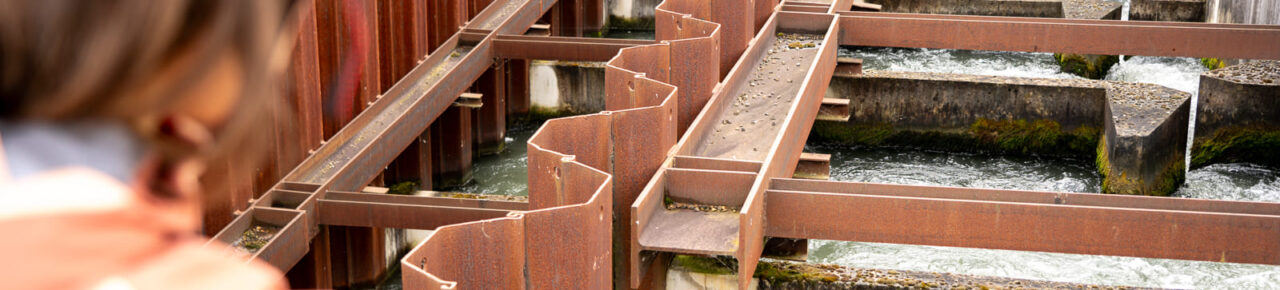
Once they’ve entered, the fish pass allows them to cross a 10-meter-high drop in elev ation, using a sort of fish staircase😛 Different pools, each one a little higher, allow them to cross the drop in elevation gradually, with the added bonus of resting pools where they can take a short break if need be. Not all fish have the same energy, depending on their species and simply on how tired they are at the time, and some will take longer than others to get through.


Visit Passage 309
Why the name passage 309 again? Simply because the pass is located at the 309th kilometer of the Rhine. The Gambsheim fish pass houses a 70m2 public reception area. It’s not very big, but there are lots of interesting information panels on migratory fish, the Rhine and how the fish pass works.
Eva and the Wonder Fish” Foxie treasure hunt
To make the visit more fun, you can download the Foxie treasure hunt (do it before the visit, as there’s not much network on site). It’s free and lasts about 1 hour.
There are also a few children’s games and large picture windows overlooking the pass’s basins, allowing you (if you’re lucky!) to watch the fish go by. Keep your eyes peeled because they don’t dawdle, I saw one go by on my visit, I didn’t think it could go so fast! You can also take an audioguide and access various observation points to see the pass’s entrances and basins. I really recommend taking an audioguide, as the main interest of the visit lies in the explanations, without which you won’t understand much of what you see!


If you opt for a “special visit” (to be booked in advance, only available on certain dates), you’ll have access behind the scenes: the counting room (a camera constantly films a pool to count the fish passing through and list them by species) and the trapping trap (which allows certain fish to be captured and fitted with a GPS tag, for example, to track their progress), plus a guide to explain how the fishway works in detail. If you can, it’s well worth it: it’s really fascinating, and makes the visit that much more lively! We are also aware of the huge amount of work carried out by the Rhin Meuse Migrateurs association to monitor fish and encourage restocking.


When can I visit the fish pass?
If you can, give preference to migration periods (April to June and September/October) and periods when it hasn’t rained too much beforehand, as this makes the water cloudy. Spring (April-May) is the best time to hope for fish sightings, but of course there’s no guarantee that you’ll see a whole pile of them on your visit! That’s nature’s charm 🙂
Ideas for Combined Tours
Have I convinced you to come visit the fish pass? To make the most of your day, here are a few ideas for places to visit and things to do in the Rhineland that you can easily combine:
- Visit the fish pass on a cycling tour of the Rhineland. You’ll find several route ideas here.
- Lunch at the Offendorf Marina
- Visit the Musée de la Batellerie in Offendorf
Rates and tickets
Click here for prices.
Access by car
The address is as follows: Fish pass Gambsheim-Rheinau, Passage sur le Rhin, 67760 Gambsheim
You have to count:
- 30 km from Strasbourg (about 30 minutes)
- 95 km from Colmar (about 1 hour and 10 minutes)
- 140 km from Mulhouse (about 1 hour and 30 minutes)
Public transport access
This is not ideal. You can take the TER to Gambsheim station, but it’s another 4km to the pass. Combining train and bike can be very practical!
This article was written as part of a paid collaboration with the Pays Rhénan Tourist Office and Alsace Destination Tourisme. I have retained complete editorial independence.