



How about a bike ride around Mulhouse? It's not the best-known area for cycling in Alsace, but there are some interesting itineraries! I'm proposing two circuits here, one that will let you discover Mulhouse's surroundings, strolling along the Rhine, and the other more urban.

1. Rhineland cycle route (58km)
Here’s a cycling loop I’ve come up with, starting from Mulhouse and taking in the Rhine strip, i.e. the part of the region along the Rhine.
My summary
I liked
- Pleasant bike ride through numerous bike paths
- Nice breaks to make along the way
- Discovery of the Rhine strip
- Easy access from Mulhouse station
I liked less
- Nothing!
An easy bike ride
The starting point is the train station of Mulhouse and the distance isabout 58km, that is to say about 3h30 of cycling without counting the breaks. It’s a bike ride that may seem a bit long if you’re not too used to it, but it’s really flat so it’s easy.
In addition, this part of the territory has many cycle routes (several Eurovélo in particular), which makes the walk more pleasant because the route follows mostly cycle tracks, small paths in the fields or roads with little traffic. Finally, there are some interesting stages that are worth stopping at, which also gives the opportunity to take a few breaks 😉


Canal du Rhône au Rhin and Hardt Forest
The first part of this cycling loop in Mulhouse Alsace Agglomération starts by following the Rhone-Rhine Canal, on theEurovélo 6. We then leave it slightly and follow the Eurovélo 6, which passes through Riedisheim (be really careful at the traffic circles there, motorists don’t pay much attention to bikes crossing the road and drive far too fast; almost every time I go by I nearly catch one that doesn’t see me…) before rejoining the canal again.
Arrived at the Pont du Bouc, we leave the Eurovélo 6 to go up on the bridge, to cross it then to pass by a road in the middle of the Forest of Hardt. From there, a huge straight line through the trees awaits you! You will cut only one road (the one which goes towards Ottmarsheim, which you should not take because you will join Ottmarsheim thereafter).
After crossing this road, the signs are not very clear and there are two bicycle lanes in front of you: you have to take the one slightly to the right, which you will follow until you find a new road. It is there that we will turn to the right to join Bantzenheim, first stage of this bicycle route. One joined Bantzenheim by a road but this one is rather little frequented, I thus did not find it unpleasant.


Visit of the Grange à Bécanes in Bantzenheim
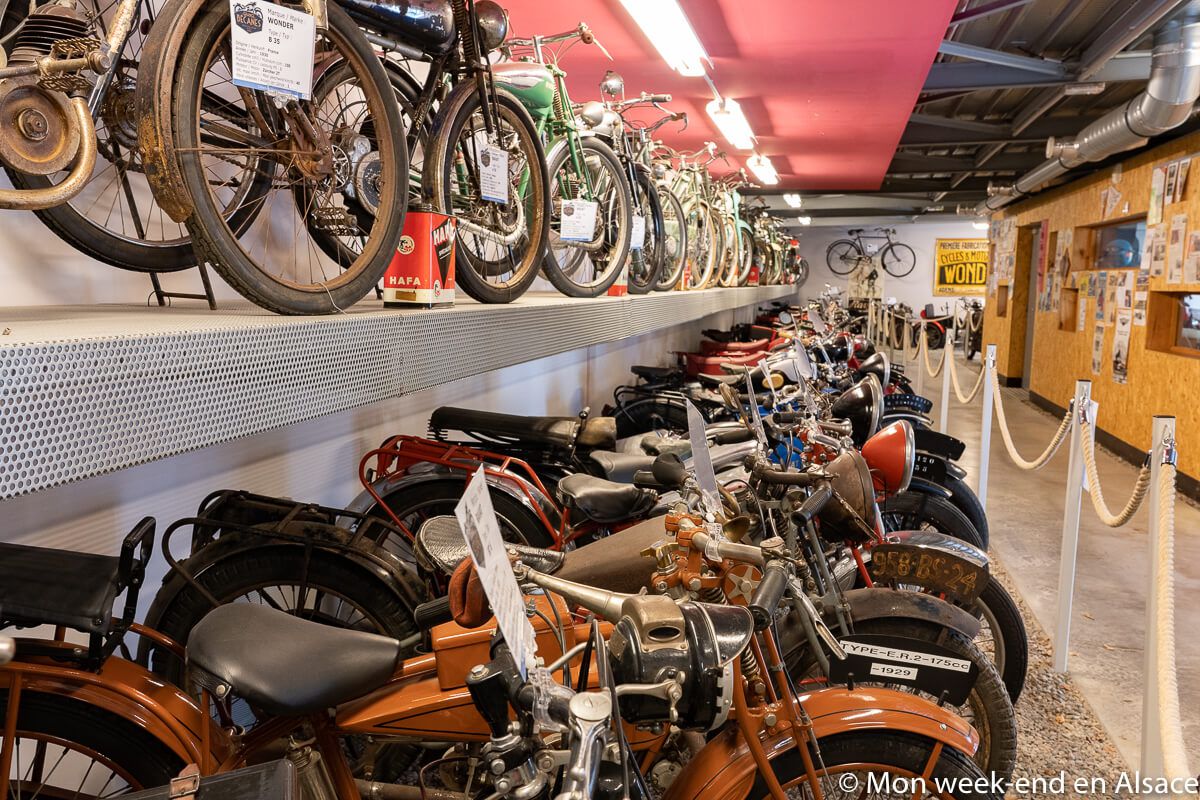
If you love vintage motorcycles, the Grange à Bécanes (Rhineland Motorcycle Museum) is a must-see. It is a small museum, which nevertheless has an impressive collection of motorcycles dating from 1920 to 1960. I am not a connoisseur, but I enjoyed discovering these beautiful old bikes. As a bonus, there are even some bikes presented, designed by a motorcycle manufacturer 😉

Discovery of the abbey church of Ottmarsheim
From Bantzenheim, you can reach Ottmarsheim in 10 minutes by following theEurovélo 15. I’ve already mentioned it in this article on my ideas for visits to Mulhouse, theabbey church of Saint-Pierre-et-Saint-Paul in Ottmarsheim is a little gem of Romanesque art, famous for its astonishing octagonal plan inspired by the chapel at Aix-la-Chapelle. I advise you to admire it from the outside, but also to enter it because this way you can really admire its architecture and the beautiful frescos that are there.


The amazing castles of Homburg
Next stop, Hombourg, which is reached by theEurovélo 15, which follows a bicycle path through the fields. I made a funny discovery there: Homburg has two amazing castles. They are both located on the Hombourg Estate (Golf de Hombourg), but it is possible to admire them from outside. One of them is located on the side of the road and reminded me of the Playmobil castle of my childhood or a movie set… It is really unusual to find it in such a place! The second one is located at the level of the parking of the Golf, it is enough to make a small detour of a few minutes to go to admire it.


The locks of Niffer
We continue on theEurovélo 15, which leads us while passing through fields until the locks of Niffer, impressive locks built at the time of the canalization of the Rhine. The command tower and the administrative building of one of them is one of Le Corbusier’s works. You may be lucky enough to see a boat passing by and to see the main lock (the biggest one) in operation, it’s impressive! There are several locks at this location, which allow boats to pass from the Rhone-Rhine Canal to the Grand Canal d’Alsace (or vice versa!), which is the canalized arm of the Rhine.
Then it’s an easy ride back along the Rhone-Rhine canal to Mulhouse (again followingEurovélo 6 and passing through Riedisheim as on the outward journey). A pleasant way to end this beautiful walk!


Practical information
Itinerary
You will find here the map and the GPX route that I created for you and here the map of the cycling facilities of Mulhouse Alsace Agglomération.
Departure and arrival
Mulhouse train station
2. Mulhouse urban art and industrial heritage trail (30km)
Want to discover more about Mulhouse by bike? I tested the BL 835 “Urban art and industrial heritage” loop, proposed by Mulhouse Alsace Agglomération andAlsace à vélo. This 30km loop, with 160m of positive ascent, passes through various districts of Mulhouse as well as a number of surrounding towns and villages, allowing you to discover two interesting facets of the city.
My summary
I liked
- Discover the different facets of Mulhouse by bike
- Numerous museums and points of interest along the route
- Easy walk (except the last climb!)
I liked less
- Course not necessarily very pretty all along
A walk to complete your visit to downtown Mulhouse
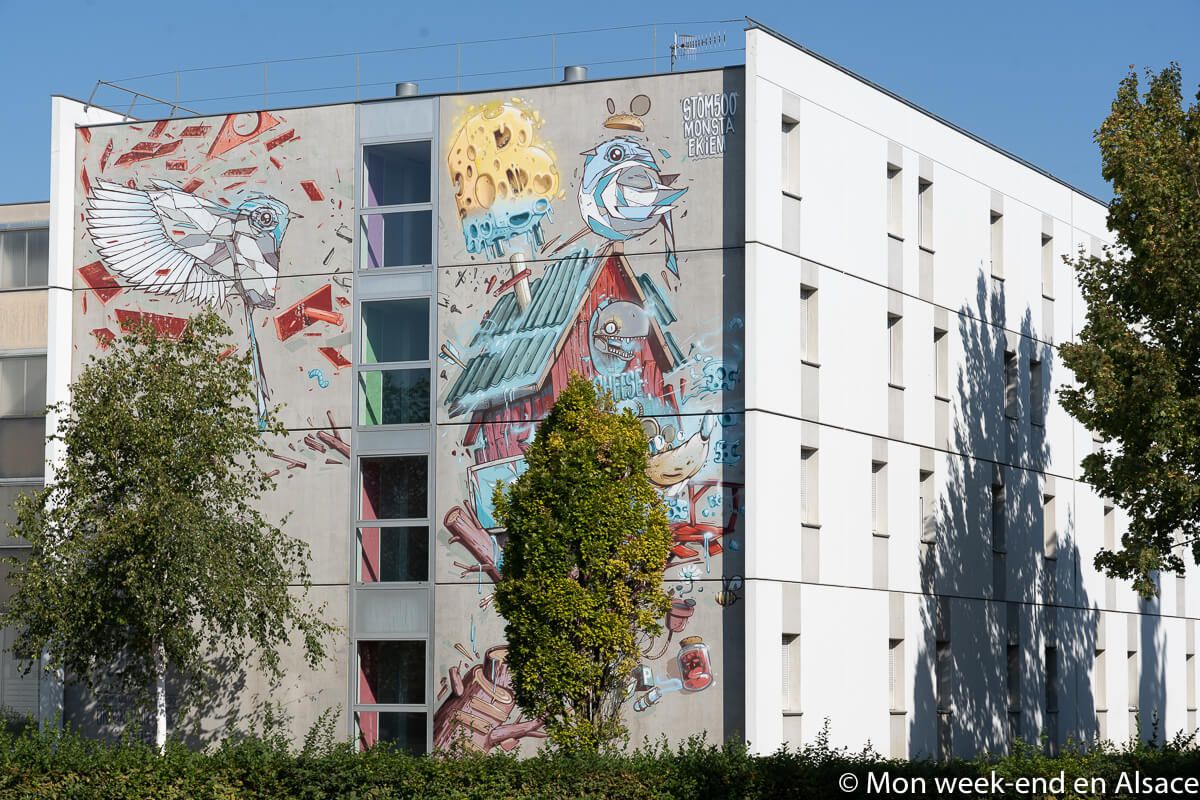
Mulhouse is a city with a rich industrial past, and boasts some fine museums on this theme, but it’s also a city where art is everywhere: sculptures, painted walls, street art… There’s plenty to admire on a stroll through the city. This bike itinerary is a good first approach to these themes, knowing that you can of course take them further by adding some ideas for activities (for those interested, I’ll tell you more below!).


You should not take this bike tour as a starting point for a discovery of Mulhouse: I think it completes a visit of the city center, by allowing you to go to places where you would not have necessarily gone spontaneously and which are nevertheless interesting. It’s not a generally bucolic loop, nor is it particularly pretty.
It sometimes passes through corners that are not particularly interesting, but it has the great merit of linking together several interesting places to visit and of offering beautiful artistic discoveries along the way. All this while being mostly on bike paths or roads with relatively little traffic (except for a few stretches). For an urban course, I think it’s a good base!


The walk step by step
The itinerary starts (and ends since it is a loop!) at the Mulhouse train station. We start by going along the Rhone-Rhine canal before passing near the former SACM foundry, which has become the Fonderie district, which now houses an industrial and digital center in its rehabilitated buildings. Then, we enjoy a little shade and greenery by passing to theIllberg, a very pleasant green space. You’ll then pass through various Mulhouse neighborhoods, with several former industrial sites and Cité ouvrières, before gradually returning to the city center, via the Canal Couvert, where you’ll find the Marché de Mulhouse on Tuesdays, Thursdays and Saturdays.
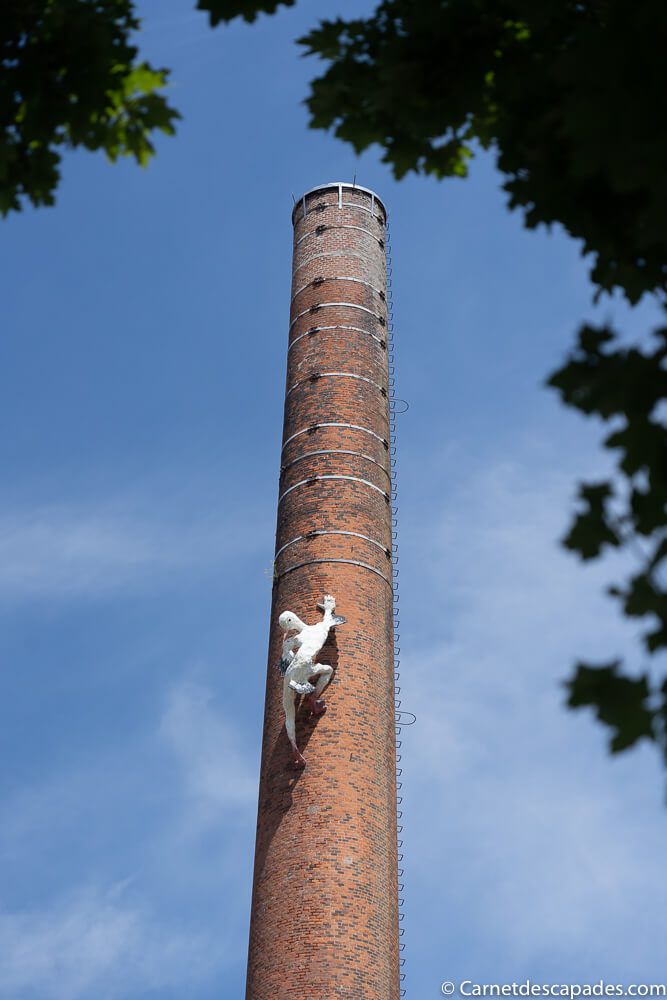
My favorite is the former DMC factory, a former textile industrial site that is really huge and whose buildings are gradually being rehabilitated. This is where you’ll find theMotoco art studio , and the Climbing Mulhouse Center climbing gym, which boasts the highest climbing wall in France (25m high!). The brick buildings are beautiful and here and there you can still see chimneys that testify to the past.
Finally, the itinerary leaves Mulhouse to reach Rixheim, where the Musée du Papier Peint is located, before returning to Mulhouse via a beautiful hill. The itinerary is globally flat and easy but this climb will test your breath and your calves 😉 This part of the itinerary is interesting to visit the Musée du Papier Peint (which I recommend, it’s a beautiful museum), but is not particularly bucolic either.



Interesting visits for further study
To complete this itinerary, here are the visits I suggest you make along the way. They are on the itinerary or only require a small detour while allowing you to deepen your discovery of the themes ofurban art and industrial heritage: it would be a shame not to take advantage of some of them!
- Visit the museums along the route: Musée National de l’Automobile, Cité du Train, Musée EDF Electropolis, Musée du Papier Peint, Musée de l’Impression sur Etoffes and Musée d’Art Contemporain (Kunsthalle).
- Reserve a Motoco Box to do a workshop with one of the artists in residence at Motoco, the creative space on the former DMC site
- In the town center, complete the loop by adding the Mulhouse Tourist Office’s street art trail, on foot or by bike.
- See the street art at Quai des Pêcheurs… And maybe even see an artist at work!
- Have a bite to eat or a drink at the Nomad, located in an old industrial building in the Fonderie district


Practical information
Itinerary
Here you’ll find the map and GPX track of the route.
Departure and arrival
Mulhouse train station